Copywriting Market Research: The Ultimate Comprehensive Guide You Need (Updated)
To write powerful copy and meet customers’ needs

Photo from Canva customized by the author
The most important step in the Copywriting process is market research.
Eugene Schwartz, one of the best copywriters in the World, said that compelling copywriting is 80% research and 20% writing. That’s the secret.
However, many newbies underestimate the power of market research.
They spend hours staring at a blank page waiting for inspiration because they don’t have enough information about the audience or the market.
But writing to meet customers’ needs is not just grabbing a pen and paper and starting to write.
If you want to achieve your copywriting goals and write copy that meets your customers’ needs, never skip the research step.
What is market research?
Market research is the process of gathering data and information about the target audience, competitors, market trends, and existing gaps in the market.
Why is market research so important in copywriting? Well, it helps copywriters understand the needs and behavior of the target audience so they can create copy that matches them.
If you want to learn more about copywriting market research, this guide is for you.
Keep reading…
Types of Market Research
There are two main types of market research:
Primary research
Secondary research
Primary research
With primary research, you can study your target audience to better understand their needs, problems, challenges, behaviors, etc. You can do it yourself.
It’s important to figure out how to position your product on the market, focusing on the right audience.
Some of the most common primary research methods are:
Surveys
Polls
Interviews
Focus Groups
Observation
Surveys and polls today are easier than ever. You can ask people directly via email, or use ads or questionnaires.
You can interview people face-to-face or over the phone and ask them what you need to know.
Focus Groups help you to conduct broader research by asking questions to a group of 4 to 12 people that match your target audience.
You can ask them questions about your product or whatever info you need.
Observation is a kind of marketing research you can do if, for example, you’re thinking of expanding your business.
It also allows you to understand existing customers’ behavior towards your existing product by collecting and recording data or observing their behavior in a natural space, like a store, for example.
Not only that, you can collect data about customers’ behaviors towards a new idea, maybe running a pre-launch campaign, so you can find out if this new version of your product meets your customers’ expectations or needs.
Secondary Research
It’s the kind of data you don’t do by yourself, but you can find by referring to other existing resources, for example, statistics, articles, reports, infographics, etc., with data already collected and published by others.
There are two types of secondary research:
Internal
External
Internal market research is all the data you have already collected from previous campaigns within your company or business, such as website analytics, existing customer data, website traffic, etc.
External market research is data you can find by researching external sources outside your company.
Some examples are
Competitors’ websites
Social media
Online reviews
Trade associations
AI research tools
Reports
You can use both primary and secondary research, or you can choose those that better fit the goal of your project.
Primary research may be a little bit expensive. It depends on what kind of primary research you need or decide to use.
You can do primary research by yourself, or if you don’t have any time, an agency or a freelancer can do it for you.
Qualitative and Quantitative Research
You can divide primary and secondary research into Qualitative and Quantitative research.
Qualitative Research:
Interviews
Focus Groups
Observation
Quantitative Research:
Surveys
Polls
Copywriting Market Research
“Always enter the conversation already taking place in the customer’s mind.”
As I mentioned above, writing copy that converts is not sitting down at your desk and staring at a blank page while waiting for inspiration.
Market research is a mandatory step you have to take to write copy that fits your target audience’s needs and the goal of your campaign.
Here is what you need to conduct effective copywriting research:
Know your target audience
Build a buyer persona
Social listening
Research industry trends
Know Your Target Audience
Effective copywriting research starts with the study of your target audience.
If you know who you are writing for, you will know how to successfully write your copy.
But how can you do that? You have to conduct demographic and psychographic analysis to thoroughly know your target audience.
Demographic Research
Some of the most relevant and popular characteristics analyzed with demographic research include:
Age
Gender
Ethnicity
Location
Language
Education
Occupation
Earnings
Marital status
Psychographic Research
With psychographic research, you can analyze different characteristics of your audience, such as:
Behaviors
Personality
Activities
Interests
Opinions
Desires
Pain points
Challenges
Bear in mind that not all products meet the needs of the same target audience. The more specific you are with this data, the better.
To do that, you need to build a buyer persona.
Demographic and psychographic research helps you build one that comes close to your real customer.
If you need, you can build more than one buyer persona.
Let’s delve into it…
Build A Buyer Persona
Before building a buyer persona, you have to understand what it is. Well, a buyer persona is a fictional character that represents your ideal customer.
It’s the result of real data you’ve gathered by studying existing customers’ behavior through interviews or surveys.
Or if you don’t have any existing customers, you can analyze your website data.
You can use analytics tools like Google Analytics to get relevant info, such as demographics, so you have a good starting point.
To give your buyer persona a human touch and make it look more real, add a photo and give it a name.
Considering the data you’ve already gathered, you can start writing a short bio to understand your persona.
You also have to consider psychographic data such as challenges or pain points, goals or aspirations, interests, social media, and objections, just to name a few.
The more data you have, the more your buyer persona will help you understand your customers’ problems.
Remember, you don’t have the same buyer persona for every product and every customer. Don’t fill in a template.
Create your buyer persona based on the customer you want to target and the outcome your customers are searching for.
Put your customers’ shoes on to go deeper into their minds, and you can provide them with the outcome they want.
Here is my example for you.
It’s a buyer persona for an Online Digital Marketing course.
It’s just an example for this post.
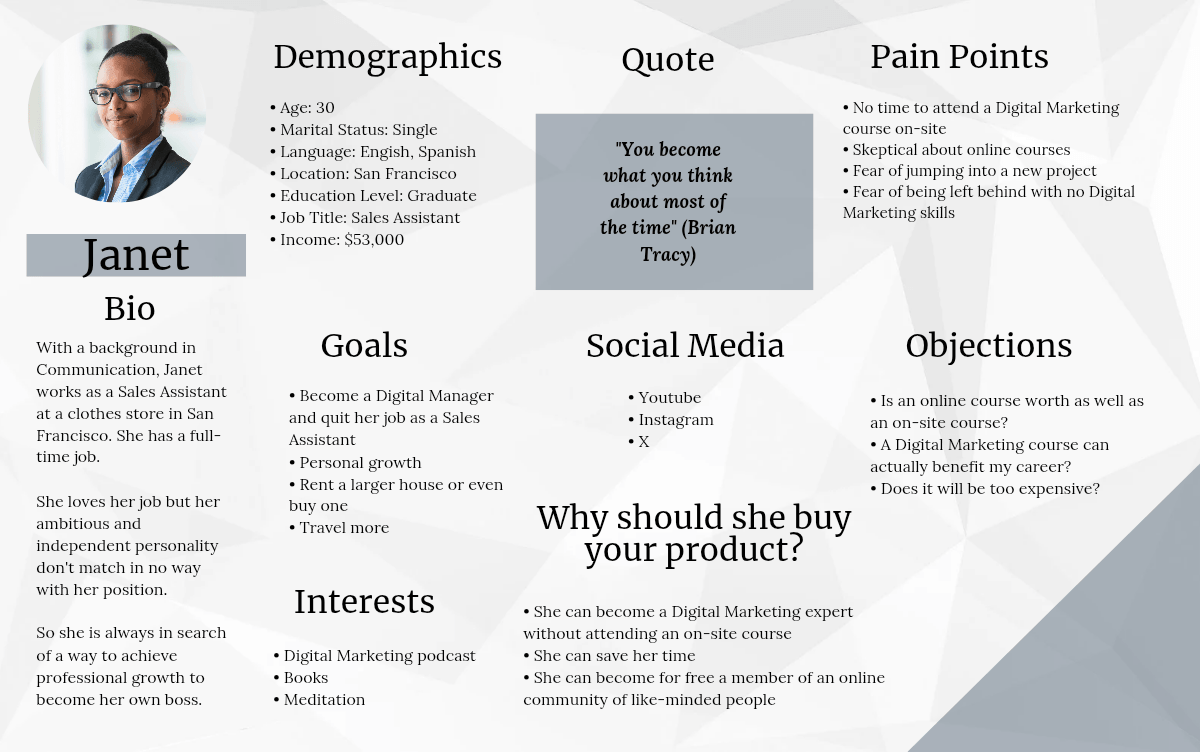
Photo customized by the author on Canva
Types Of Buyer Persona
Some research identifies 6 types of buyer personas:
The Perfectionist
The innovator
The Loyalist
The Value Seeker
The Impulsive Buyer
The Bargain Hunter
The Perfectionist wants the best product or service, no matter how high the price is. He wants quality.
The Innovator is a person who never misses a new version of a product, and he/she is always up-to-date with any technology news.
The Loyalist has been loyal for ages to the same brand.
The Value Seeker buys something only after comparing prices to find top-notch products at the best price.
The Impulsive Buyer makes a purchase based on emotion without overthinking about the product.
The Bargain Hunter is always searching for discounts and special offers to save money and make a deal.
Social Listening
Social listening helps marketers to know what people think or say about a product, a service, or a brand, so they can understand what works more, what doesn’t, and what they have to improve.
It’s an essential step for copywriters to write engaging copy that meets people’s needs and to promote products the right way.
But not only that. You can use social listening to measure customer engagement in a marketing campaign through likes, mentions, retweets, hashtags, relevant keywords, etc.
It helps you to identify influencers and top talent, and by monitoring what people say about your product or you, you can protect your brand reputation and improve customer service.
Thanks to social listening and its valuable insights, you can better understand keyword trends and find out new topics to write about, tailored to your customers’ needs.
It also allows you to track and measure marketing campaigns, analyzing customer insights.
Social Listening Tools
Here are some of the most popular tools for social listening:
XPro
Keyhole
Brandwatch
BuzzSumo
Sprout Social
Buffer
Sprinklr
Brand24
Hootsuite
Agorapulse
Mention
XPro
Earlier branded as TweetDeck, it’s a social listening tool by Twitter, now rebranded as XPro.
It’s no longer a free tool, but if you want to use it, you have to pay for a subscription and verify your accounts.
Only verified accounts can access data on XPro.
It allows you to manage multiple X accounts and other social media accounts at the same time.
Keyhole
It helps you with your social media analytics by analyzing campaigns, multiple profiles, brand mentions, trends, and influencers.
To get the Keyhole social listening tool, you have to book a demo. It’s now available on Muck Rack.
Brandwatch
It allows brands to do market research, monitor, analyze, and manage their online presence on social media and consumers’ reviews about their brands.
You can choose among three different plans:
Consumer Intelligence: For researchers and analysts
Social Media Management: For Social Media Managers
Influencer Marketing: For influencer Marketers
But if you want to know the price of each plan, you have to book a meeting directly with the website company so they can suggest the right solution for you.
BuzzSumo
BuzzSumo is probably one of the most well-known tools for data-driven research that helps copywriters and content creators write engaging copy by monitoring and analyzing trends, audiences, and brands.
You can start with a 30-day free trial and then choose among four different plans:
Content Creation: for marketing agencies and content creators, for $199/month if billed monthly, $159/month if billed yearly
PR & Comms: for agencies for $299/month billed monthly, $239/month when billed yearly
Suite: for teams in large agencies for $499/month billed monthly, $399/month if billed yearly
Enterprise: everything for agencies and brands for $999/month, but only billed yearly
Sprout Social
It’s a social media management tool for businesses to track social media analytics, create reports, and share performance data.
You can start with a 30-day trial and then choose the right solution for you. Here are the plans, billed annually.
Standard 》for $199/month
Professional 》for $299/month
Advanced 》at $399/month
Enterprise 》it’s a customized plan, so if you opt for this plan, you have to contact the company to ask for the price.
Buffer
It’s another popular tool that helps you build your audience, publish your content, and provide you with automated reports.
You can choose the plan that meets your needs the most. Here are the available solutions:
Free
Essential
Team
Free: to start with social media management. You can connect only 3 channels.
If you want to connect more than 3 channels, you can opt for the other solutions.
For subscription plans, you can start with a 14-day free trial and then choose the right solution for you among the solutions below:
Essential: $5/month per channel billed yearly, $6/month when billed monthly
Team: $10/month per channel billed yearly. If billed monthly, you’ll pay $12/month
For more than 10 channels, you have to reach out to the team for a customized plan.
If you want to go deeper with the Buffer pricing plan, click the link and choose your best solution.
Sprinklr
With Sprinklr, you can plan and manage your content across 30+ digital channels.
You can have a 1:1 chat service to assist your customers through the buying process.
Thanks to an advanced AI capability, Sprinklr makes product recommendations so sales specialists can deliver valuable advice that helps brands boost their engagement.
Sprinklr can do many other things for your biz. If you want to know more about it and its pricing plan, click here, and you can find all the info you need.
Brand24
It’s an AI social listening tool to monitor mentions and comments about a brand to protect online brand reputation.
You can track hashtags, monitor metrics, and customer insights, and get Slack integration.
You can start with a 14-day free trial and then opt for one of the solutions below:
Individual: for small brands, $249 per month for a monthly plan; if you choose to pay annually, you’ll pay $199 per month
Team: for small businesses and startups, for $349/month if billed monthly or $299/month when billed yearly
Pro: for small agencies and growing businesses at $499 per month if billed monthly. When billed annually, you’ll pay $399 per month.
Business: for establishing agencies and scaling businesses for $699/month when billed monthly. For $599/month if billed annually
Enterprise: for large agencies and enterprises, for $1499/month billed annually
Hootsuite
With Hootsuite, you can create, organize, and schedule your social media posts, get suggestions about the best time to post your content, monitor trends, what your competitors do, and how your business is working.
An important feature is the integration with many apps and the most popular social media platforms.
It helps you with your social media advertising and other valuable features.
You can start with a free 14-day trial, and then you can opt for one of the plans below:
Standard: for € 99 per user/month
Professional: for €199 per user/month
Advanced: for €399 per user/month
Enterprise: It’s a custom plan. You have to contact the company for pricing and to request a demo.
Note from the Hootsuite official website:
Prices displayed in EUR, based on annual billing, but do not include applicable taxes. Trial accounts have daily posting limits (10-20 posts per organization, depending on plan). Bulk scheduling is not available during trial.
Agorapulse
It’s an easy-to-use social listening tool, but not only that. You can have other features that help you:
Create and analyze reports
Monitor your conversions
Manage your social media content planning and scheduling
Unify social media message management
You can have different solutions to opt for.
You can start with a Free trial for 30 days.
Then, if you want to switch to a subscription plan, you can choose among:
Standard: €99 per user/month if billed monthly, €79 per user/month if billed annually
Professional: €149 per user/month if billed monthly, and €119 per user/month if you choose to pay annually
Advanced: €199 per user/month billed monthly; if billed annually, you’ll pay €149 per user/month
Custom: You have to reach out to the company to request a demo
Mention
With Mention, you can:
Monitor online blogs, social media, forums, and any other online source
Analyze what people say about you and your competitors
Monitor audience insights
Build your social media strategy and editorial calendar
And many other features
If you want to give it a try, you can start for free and then get a demo.
For more info, go to the Mention website.
Research Industry Trends
Researching industry trends is a process that helps you gather valuable information to write effective copy.
Google Trends is the most popular tool for researching industry trends and coming up with content ideas, both general and niche-related.
Surveys and Polls
Other tools you can use to research industry trends are surveys and polls.
This data helps you to understand customers’ problems, challenges, and needs so you can effectively tailor your content, products, or services to your customers’ needs.
Keyword Research
An essential step in researching industry trends is searching for related keywords used by your audience, especially in your niche.
This step is crucial for copywriters for many reasons.
First of all, by using the right keywords, you can boost your ranking on Google SERP by writing SEO-friendly copy.
Not only that, you can write persuasive copy because you know what people are searching for.
Here are some of the most popular tools you can use, both for content ideas and keyword research:
But the list can go on and on.
Additional Market Research Tools
Reviews and Feedback
Forums and Q&A Sections
A/B Testing
KPIs
Reviews and Feedback
Effective copywriting is writing as your customers talk. What does that mean? It means you have to use a language your customer is familiar with so they feel understood.
How can you know how people talk? Search for product reviews and read what people think about a product or service.
By taking care, especially of negative reviews, you can write copy that meets your customers’ needs and beats your competition.
Negative reviews and feedback are a great opportunity for brands to improve their products and understand what they have to keep and what changes to make in their strategy.
An excellent place to find customer reviews and understand customers’ needs is Amazon.
Forums and Q&A Sections
Forums and Q&A sections are great places to know what customers think about a brand, a product, or an experience.
By reading forums, especially market-related ones, you can figure out what struggles people are going through, what their goals are, their fears, etc.
The best way to write as people talk and meet people’s needs is by joining their conversations and providing answers, suggestions, and solutions.
Not only that, you can ask them questions related to your products or services to understand what they like or don't like.
This is also an incredible way to establish trust with them and turn cold connections into future clients.
Some examples of this kind of platform are:
Quora
Reddit
And all the different online communities and forums.
A/B Testing
One of the most valuable tools in market research is A/B Testing. It’s also called Split Testing.
It’s an essential method used in any effective marketing strategy for copywriters and digital marketers to analyze the success of any ad campaign and test customer engagement.
It consists of writing the same copy in two versions or more, if you need it, and choosing an element of the copy to test.
Here is an example…
You have a landing page to promote your online course, and you want to test different headlines to see which performs better.
To run an A/B test, you have to write the same landing page but with two different headlines.
Once you have created the two versions of your landing pages, you can name them by adding “A” and “B” to the name of your campaign to differentiate them.
The next step is sending one version to half of your customers and the other version to the remaining half of your customers, so you can test your landing pages.
Studying the results allows you to understand which headlines perform better and drive more sales.
Headlines are not the only element of your copy you can test. You can also test the effectiveness of your CTA, your subscription form, etc.
KPIs
A KPI is a metric used in market research to measure the performance of a marketing campaign, a website, or an app.
KPI stands for Key Performance Indicators, and there are different KPIs to track.
But how can you decide what KPI you need to track?
First of all, you have to think clearly about your research goals and objectives, and then you can decide which KPI you need to monitor to achieve your research goals.
Let’s see some KPI examples you need to measure as a copywriter:
If you want to analyze a website’s success, for example, you need to measure different metrics, like traffic sources, page views, and user behavior, just to name a few.
To track these metrics, you can use analytics tools. One of the most popular, as I’ve said before in this post, is Google Analytics.
Other KPIs you can measure are:
Conversation rates
Click-through rates
Social media sharing
Engagement metrics
Customer feedback
If you need to measure a marketing campaign’s success, for example, you have to analyze some other KPIs, such as Open rate, Bounce rate, Unsubscribe rate, ROI, etc.
And as I’ve said before, which KPI you need to measure depends on the goal of your campaign.
Copywriting Marketing Research With ChatGPT: A Quick Overview
Most copywriters or aspiring ones are frightened by the growth of AI, especially from ChatGPT.
The most recurring question that everybody asks is: “Will ChatGPT replace my copywriting job?”
Like you, I was worried about that too. But the answer to this question is: No, it won’t.
ChatGPT won’t replace copywriters; rather, it’s going to be a great tool to assist them in the copywriting process.
To be more precise, it can help copywriters speed up the research process, come up with new topic ideas, and suggest outlines to inspire them.
It can also summarize articles or books, but it can’t totally replace them.
Why?
Because of “human psychology”, the ace up the sleeve of copywriters.
What does it mean? It means that ChatGPT can’t write copy based on human psychology.
And as you know, people buy based on emotions, and only humans can write copy for humans that arouses emotions. And copywriters do.
How Can You Use ChatGPT To Do Market Research?
You can use it to define your target audience by researching demographics, psychographics, and all you need to build your customer persona.
You can build a customer persona from scratch if you have all the info you need.
Remember, the more detailed your prompt is, the more accurate the answer ChatGPT provides you.
Never copy and paste ChatGPT results, but be consistent with your brand tone of voice.
Edit, rewrite, and check all the ChatGPT info, especially statistical data, to be sure all data is up-to-date.
It’s a valuable assistant. But you’re the copywriter.
Competitor Analysis
It’s probably the most important process in market research. You can do it every six months or once a year; it depends on your needs.
It helps you better understand your competitors’ strategy, what works more for them, their products or services, and their sales process.
It’s also useful to highlight what your competitor is doing wrong so you can fill this gap with the right strategy, and to learn how to avoid doing the same.
And not only, it help you establish your UVP, or Unique Value Proposition, and your competitive advantage.
But how to conduct a competitor analysis?
First of all, you have to identify your competitors.
Competitors can be:
Direct
Indirect
Direct competitors sell the same product in the same market.
Indirect Competitors sell different products in the same market.
Then search for competitors’
Social media profiles
Customers’ reviews
Keywords
Price strategy
Products
Marketing campaigns
To conduct effective competitor analysis, you can use tools like SpyFu and Semrush.
I also want to mention Social Blade.
It’s a tool to track social media stats and keywords from the most-used social media apps.
You can start with Social Blade for free with a 30-day free trial, and then you can opt for a premium subscription and choose the plan that matches your needs.
If you want more details about this tool and the price plans, you can click here.
In a competitive landscape where every business has a social media presence, tools like Social Blade can be essential for conducting a competitor analysis of your social media platform.
You can also track competitors’ analytics and look at what your competitors are doing well and what kind of content they are posting.
So you can gain insights into what you’re doing right or what you have to change in your social media strategy to stand out.
But remember, never steal competitors’ ideas or copy their content. Be inspired by them, but write your content with your brand’s tone of voice.
To develop a brand strategy that attracts customers like a magnet and beats the competition, you have to go deeper into all factors and perform a SWOT analysis of your competitors.
Once you’ve collected all the data you need, you can compare it with yours.
SWOT Analysis
What does SWOT analysis mean?
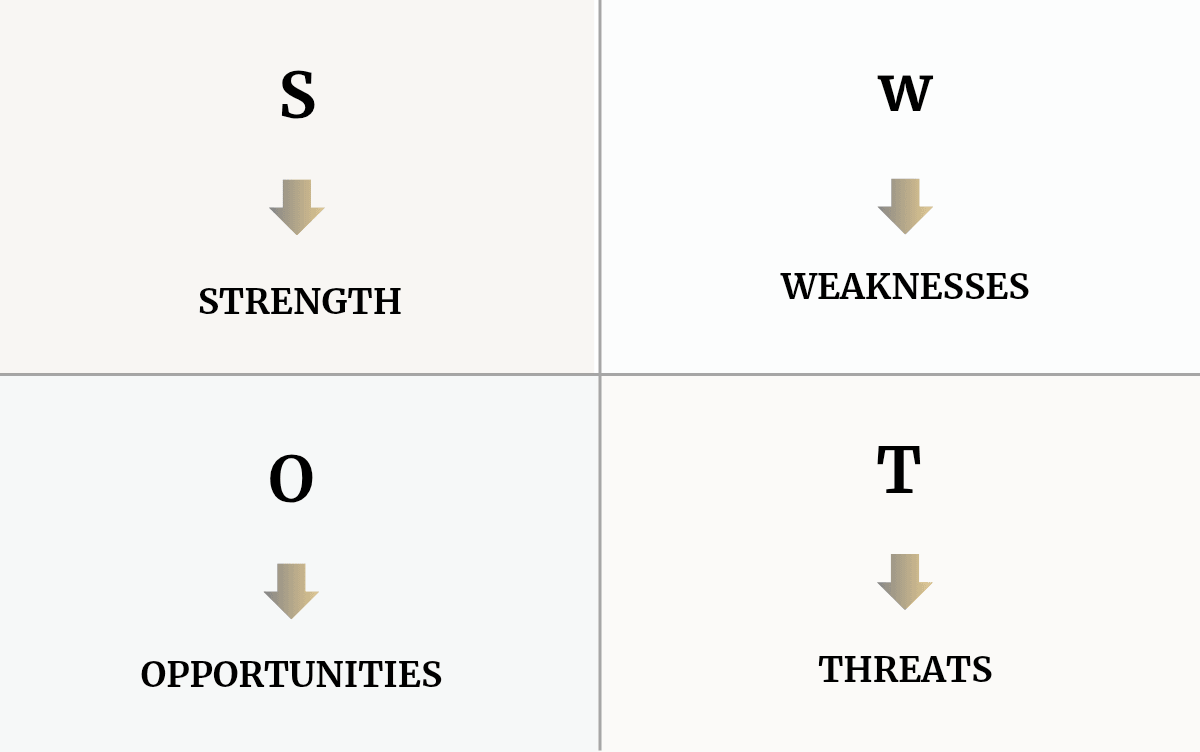
Photo customized by the author on Canva
The acronym SWOT stands for
S 》Strengths
W 》Weaknesses
O 》Opportunities
T 》Threats
Strengths are internal factors that allow you to stand out from competitors. Skills, customer care, your product, project delivery, reliability, etc.
Those are what make you different from your competitors and what works best.
Weaknesses are internal factors too, but those don’t work well and can slow down the growth process.
For example, your company doesn’t provide recurring training to the team, and in a market that evolves so fast, problems like that must be fixed as soon as possible.
So analyzing weaknesses is crucial to figure out what doesn’t work in your strategy to improve it.
Opportunities are the most important section for you if you want to grow and scale your business.
Those are external factors. Think, for example, about a new market niche to enter, or maybe a new technology that can help to grow your biz.
Or think about new networking opportunities to get high-ticket clients to go to the next level in your copywriting career.
Threats are external factors too. Those are, for example, new potential competitors, obsolete tools or technology, and other factors that you can’t control.
Benchmarking
With benchmarking, you can compare your strategies, processes, and performance with your competitors.
It allows you to figure out what you need to change and improve in your strategy, and which new and different goals you have to set compared to competitors.
First, you have to define the objective and what KPI you want to compare and measure, then analyze all the info you’ve gathered and apply the results you’ve got from the benchmarking.
You can divide Benchmarking strategies into three categories:
Internal
External
Functional
Integral
You can do Internal Benchmarking when you want to gain insights from different companies within your own company or agency to identify what works and what doesn’t, and work on what needs improvement.
With External Benchmarking, you compare your own brand with other brands or competitors, direct or indirect.
So you can analyze strengths, weaknesses, advertising campaigns, and channels to reach their audience, pricing strategy, etc.
By comparing the most relevant data, you can understand what you have to improve to stand out.
If you want to compare your brand with top-notch ones, even if they are not related to yours, you can do Functional Benchmarking to gain inspiration about the kind of content they share and their strategy, so you can improve yours and be a step ahead.
To delve into your analysis, you can do an Integral Benchmarking.
Look at all the data you’ve gathered with internal, external, and functional Benchmarking.
By merging them, you can have an overall view of every change you have to make to take your biz to the next level and outdo your competitors.
Conclusion
Writing copy that delivers value to your audience, genuinely persuades them, and gives them a real solution to their problems or struggles doesn’t happen by chance.
Behind effective copy, there is a deep understanding of the audience, the market, and the competition.
And here market research comes into play. It’s the first step, the foundation for writing converting copy tailored to your customers’ needs.
There are different kinds of market research, and you can choose the one that matches the goal you want to reach.
Once you’ve set the goals of your research, you need to build a buyer persona so you can write copy that draws audience attention.
To write copy that resonates with your audience, you have to deeply understand what your audience thinks and speaks, especially the lingo used.
Social listening, trend research, keyword research, reviews, feedback, forums, and Q&A sections are the best ways to delve into audience understanding.
If you want to test the effectiveness of your copy and figure out which copy converts more, run an A/B test and analyze KPIs.
AI tools like ChatGPT can help you save time and speed up the research process.
ChatGPT can assist you, but you can’t rely on it for the data. Check if every piece of data is up-to-date.
Another important step in the research process is competitor analysis.
Understanding your competitors can help you write copy that stands out.
With a deep understanding of your competitors, their content strategy, and what they are doing well or badly, you can establish your UVP, understand your strengths, and create copy that beats your competitors.
To conduct an in-depth competitor analysis, tools like SWOT analysis and benchmarking are what you need.
To wrap up, market research is an essential step for any effective marketing strategy, but especially for copywriters.
“Doing your homework,” as David Ogilvy said, is way more important than grabbing a pen and a notepad and starting to write, having no clue about your audience or your product.
Market research is your “homework” that helps you to write copy that sparks customers’ interest, solves their problems, and brings you money.
Note: This article was originally published on Medium.
Disclosure: This article includes links, but none of them are affiliate links. If you click on them, buy a product, or sign up for a subscription, I don’t get any commission.
Have a copywriting project in mind?
Want to discuss your next big idea? I’d love to connect. Click below to request your free audit, and together we will find the perfect solution to level up your copy.