7 Powerful Principles You Need To Boost Conversions
A short guide to Cialdini’s Principles
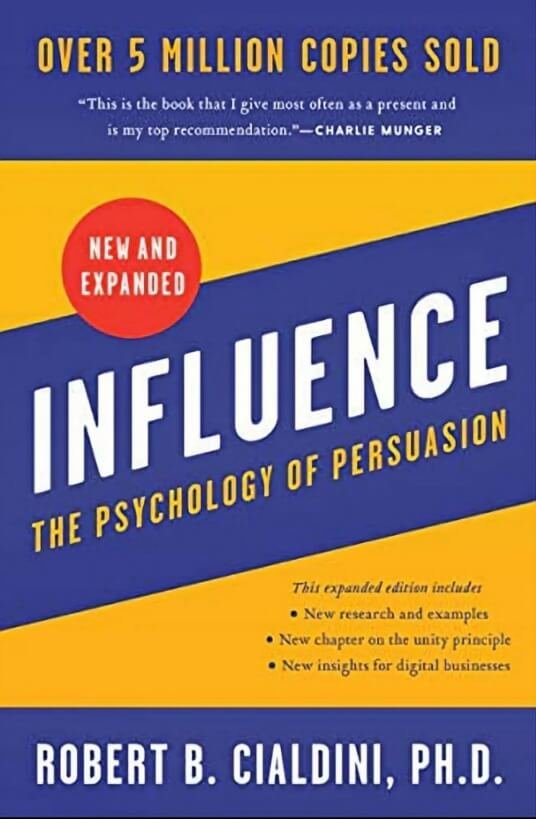
Photo by Amazon
What does “persuasion” mean in copywriting?
As you know, copywriting uses written words to persuade people to take a given action.
To write copy that persuades people to click the CTA button, you have to learn how to use the “right” words persuasively.
Robert Cialdini identified 7 principles of persuasion that help you write compelling copy.
Cialdini doesn’t talk about persuasion as something to use to manipulate people on a negative side, but he talks about genuine persuasion.
Influence vs Manipulation
As I’ve previously said, Cialdini talks about genuine persuasion to influence people positively.
Persuasion leads prospects through each stage of the sales funnel, helping them trust a product or a service and click the buy button.
It’s essential to know the difference between persuasion as “Influence” and persuasion as “Manipulation”.
Influence has the aim to persuade people to take action without misleading them. You have to influence people by informing them about the benefits and future of your product or service, proving that your product is the solution to the problem. That’s the secret to writing copy that converts, influencing people to fulfill a need they have.
Manipulation is negative persuasion. It’s influencing people to do something “you” want to fulfill “your” needs. When you manipulate people, you are not influencing them honestly; you are lying to them for your own interest.
How to use persuasion in copywriting
In copywriting, never use persuasion to manipulate people, because writing copy is persuading people to buy from you by building trust, loyalty, and solving people’s problems, but never cheating them.
Knowing the difference between influence and manipulation is important for you and your prospect.
For you, it’s important to understand how people use persuasion with you.
For your prospect, when you understand how to influence people in the right and honest way, you can write copy that persuades them to click your CTA button, giving a solution without manipulating.
So, not only do you achieve your CTA goal, but your prospect will buy from you repeatedly.
Influence: The Psychology of Persuasion
Cialdini talked about the principles of persuasion in his book “Influence: The Psychology of Persuasion”, in his first edition published in 1984, and then in his expanded edition published in 2021.
In the first edition, he identified 6 principles of persuasion:
Reciprocity
Liking
Social Proof
Authority
Scarcity
Commitment and Consistency
In the new and expanded edition, he added Unity to the other 6.
Let’s delve into the 7 principles of persuasion…
#1 Reciprocity
According to Cialdini, it’s the most important principle. It dates back to the history of every human society, when the principle of reciprocity was called “barter”.
When you give somebody something, he will give you something in return. It’s the tendency of every human being. And that’s the principle of “reciprocity”.
In copywriting, the best example of that principle is when you give something valuable to your reader for free by creating digital products. It’s called a “Lead Magnet.”
People love free stuff, and if you give them something really valuable and helpful for free, they are more likely to give back some personal info, for example, their email address.
Lead magnet ideas: ebooks, special reports, case studies, infographics, etc.
#2 Liking
The most important factor here is “similarity” because it is proven that human beings like people who are similar to them.
And not only that, here “familiarity’’ plays an important role in the sense of collaboration, connection, and networking.
Familiarity also matters with prospects. You can use this principle in copywriting by following some strategies.
You have to study your audience to know them better, so you can highlight the similarities and create familiarity when you talk with them.
#3 Social Proof
People tend to follow other people when they have to make a decision.
This principle is important to decrease prospect skepticism about a product or a service, helping them choose something new with confidence.
Social proof increases confidence in a product because other people have already used it and tested it, and so there is no doubt that it will be ok for them too.
People are more motivated to buy a product after reading reviews, watching video testimonials, or reading stats.
Talking about reviews, when a prospect reads product reviews to know something more about a product he wants to buy, he doesn’t consider reviews too high, because they think are less truthful if too positive.
Cialdini states that the review rating with the higher conversion rate is between 4.2 and 4.7, and not 5.0 because it is less credible.
#4 Authority
According to Cialdini, authority is not always a bad thing. Authority in the sense of knowledgeable people is good. And sometimes following an expert, an “authority”, can be a shortcut to achieving a result.
People consider different elements that help them trust someone based on authority. For example, they consider titles, clothes, and jewelry.
How do you apply the authority principle in copywriting?
Showing your skills “in action” means writing. Consistency is the key. You have to write online as much as you can, writing blog posts, social content, and above all, building your portfolio, especially if you are starting out.
The more you know about a topic, the more people see you as an expert, an authority in your field.
To make people trust you, you can use testimonials in your copy from people who are happy with your product or service, testimonials from other experts, or your certifications if you have some.
But remember, you only have to add “real” testimonials. Never dupe a customer; otherwise, you will lose him immediately.
#5 Scarcity
According to the famous salesman, Zig Ziglar, “people buy based on emotion and justify it with logic.”
The idea of scarcity is a feeling that tells your prospect that there is no time to wait to buy a product.
When you write copy, use the FOMO technique. FOMO stands for “Fear Of Missing Out”. People fear losing a product, especially when it is limited. Adding scarcity helps you persuade more with your copy.
Scarcity can be:
In time
In supply
Exclusivity
Limited seats
Examples of scarcity in time are offers with a limited time or with a short deadline. For example: “Only for this week”, “This offer expires at midnight”, etc.
Scarcity in supply is when you say you only have a certain quantity of a product. For example: “Only 5 left”, etc.
Exclusivity is a great element of persuasion because people want to stand out from the crowd. Buying something exclusive, “limited edition”, makes them feel special.
You can use scarcity, for example, to promote a webinar by adding a limited seat offer, so the reader who is serious about learning more about a topic will register for the webinar without thinking too much.
When you write copy, it’s important to highlight the benefits, the uniqueness of what you’re offering, and what they can lose if they won’t buy your product, especially when you write copy using the principle of scarcity.
#6 Commitment and Consistency
Cialdini highlights the importance of committing yourself, but only when you really want something and when you feel that is right; otherwise, it will be impossible to stay consistent.
Consistency is essential to achieving results, and it’s a sign of a strong personality.
Once you commit yourself to do something, you have to be consistent in the future with every word previously said, every promise previously made, or every action previously done, publicly and privately.
How can you apply commitment in your copy? You have to ask for small initial commitments.
Start with engaging your customer with a freebie, or with a low-ticket offer, depending on your goal, and write a clear CTA.
Your customer will commit to you by taking the first step. Then, with the right pressure, using the right email marketing strategy, you can gain his trust.
So, he keeps behaving consistently with the initial commitment, and you can achieve your final goal: sell your product.
Remember, initial small commitments will persuade people to buy from you.
#7 Unity
This principle looks at people as a tribe’s identity. People want to feel like one of that tribe and have something in common.
Unity doesn’t consider similarity but the desire to belong aimed at a sense of connection.
Unity considers:
The commonality of lifestyle and habits
The commonality of place
The commonality of language
The commonality of the family
The commonality of lifestyle and habits is a way to define themselves by spending time with people who have habits that match theirs.
The commonality of place is something related to the idea of “local”, the idea of growing up in groups in the same place.
The commonality of language is related to native speakers. It’s speaking the same language. It’s considering the accent of the speaker and feeling a sense of belonging when they talk with people who have the same accent.
Last but not least, “commonality of the family”. Family is the first place where you can see the principle of unity in action. It’s the first “tribe” people belong to.
To sum up
Do you want to influence people to say “yes” and click your CTA button? The key is to use Cialdini Principles.
Give value to your prospect, and you will have something in return. Free stuff draws people’s attention.
Knowing your audience helps you to tailor the right offer for them, highlighting similarities and creating familiarity.
Use social proof and testimonials to gain trust.
Show your audience you’re an expert in what you do by sharing content, answering their questions, and building a portfolio, as I previously said, especially if you are starting. So your audience will see you as an “authority” in your field.
Use scarcity in your copy- only real, not fake- and your prospects won’t ever lose the deal.
Make your offer so desirable that your audience commits themselves to you and keeps buying from you consistently.
And lastly, make your audience feel a sense of belonging to your “tribe”, for example, creating groups of people who have the same interests and goals.
Note: This article was originally published on Medium.
Disclosure: This article contains a link, but it’s not an affiliate link, so if you click on it, I don’t earn any commission.
Need Persuasive Copy For Your Next Project?
Whether you have a question about this article or want to discuss your next campaign, I’d love to connect. Click below to request your free audit and start the conversation.